



Wholesale furniture sourcing looks straightforward from a distance: choose a few models, request prices and place an order. The difficult questions usually appear later.
Can the sofa dimensions be adjusted without changing its proportions? Will the fabric used for the sample match the production batch? Can dining chairs, beds and cabinets be coordinated under one material direction? What happens when an interior project needs room labels, revised drawings and phased delivery?
This is where wholesale custom furniture differs from ordinary stock purchasing. Wholesalers, retailers, sourcing agents and contractors are not only buying products. They are building a repeatable supply process around specifications, samples, pricing, quality and delivery.
The practical answer:source wholesale furniture by sending the same written brief to a shortlist of qualified suppliers, checking their actual manufacturing capabilities, approving materials and samples, comparing complete project costs and documenting every change before bulk production.
Not every wholesale order needs a custom manufacturer. Sometimes available stock is the sensible choice. In other cases, buying a standard product would create more compromises than savings.
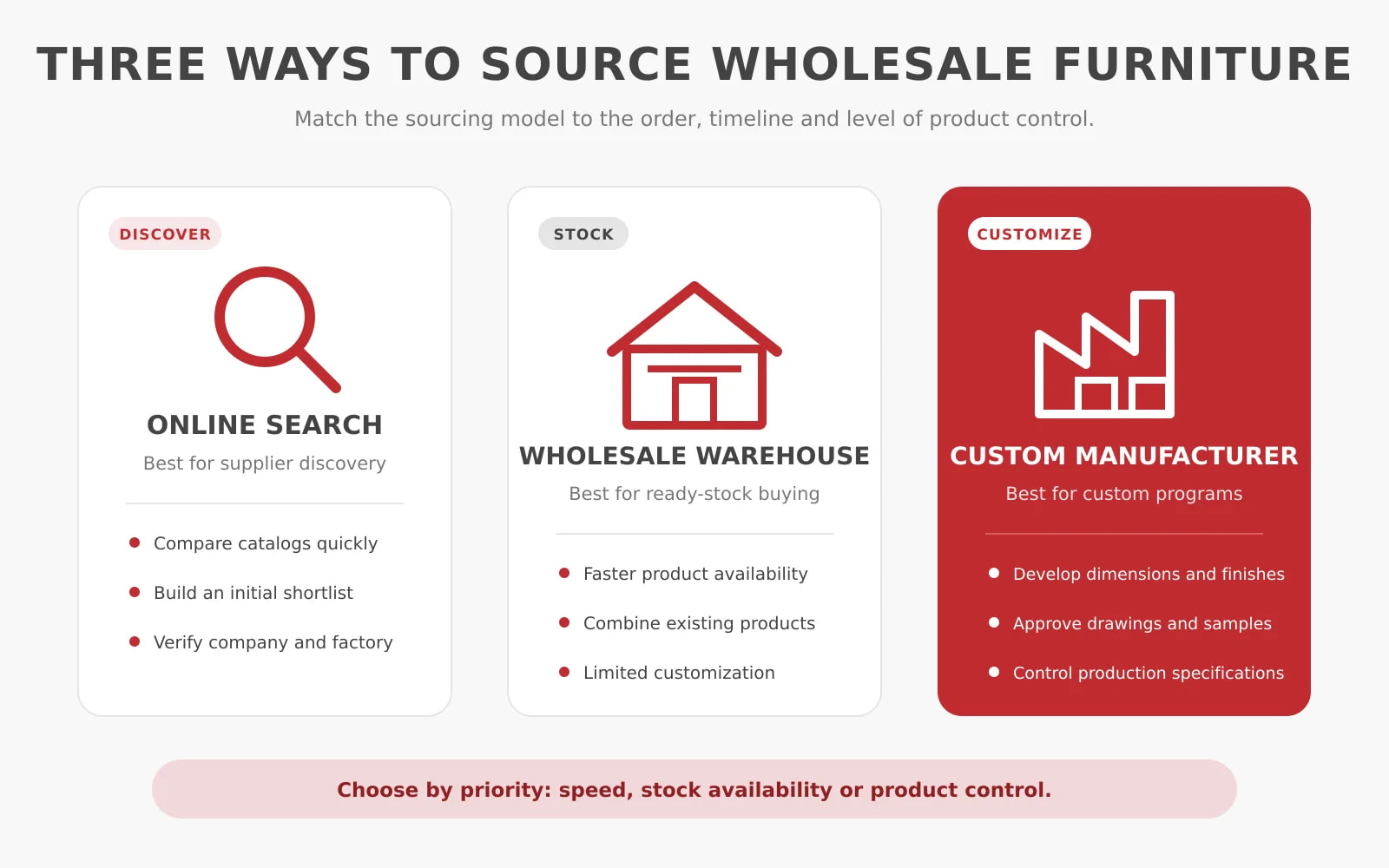
| Buying Model | Best Suited To | Main Advantage | Main Limitation |
|---|---|---|---|
| Ready-stock wholesale | Fast replenishment, small retailers and short delivery windows | Products may be available immediately | Limited control over dimensions, materials and exclusivity |
| Warehouse-based sourcing | Buyers combining existing products from several collections | Convenient stock selection and possible order consolidation | Product origins and customization options may be limited |
| Custom furniture manufacturing | Retail collections, private-label programs and interior projects | Greater control over design, specifications and materials | Requires development, approval and production time |
A furniture wholesale warehouse can be the right answer when delivery speed matters more than product differentiation. Custom manufacturing becomes more valuable when the buyer needs a specific size, material palette, construction standard or coordinated collection.
Clarifying this distinction at the beginning prevents a common sourcing mistake: expecting warehouse speed, factory-level customization and the lowest possible price from the same order.

“We need modern furniture at a good price” may describe the general goal, but it does not give a supplier enough information to quote accurately.
A useful wholesale furniture brief should explain what is fixed, what can change and what still needs the manufacturer’s recommendation.
Product categories and target number of SKUs
Estimated quantity per model or color
Target retail positioning and purchasing budget
Preferred dimensions, materials and colors
Standard options that customers may choose from
Packaging, barcode, logo and labeling requirements
Target launch date and expected repeat-order pattern
Floor plans, elevations and reference images
Furniture schedule or bill of quantities
Item codes and room locations
Required dimensions and configurations
Material, color and finish direction
Sample-room or mock-up requirements
Site schedule and required delivery date
Installation, labeling or phased-delivery requirements
Specific language makes a real difference. Instead of requesting “a beige modern sofa,” a buyer might specify a maximum overall width, required seat count, warm greige upholstery direction, medium-firm sitting feel and the target room or retail price level.
The manufacturer can then respond to the actual requirement instead of guessing what “modern,” “beige” or “good quality” means to the buyer.
Searching for wholesale furniture online is useful for building an initial list. It allows buyers to compare product directions, manufacturing locations and apparent category strengths without travelling to every supplier.
It is only the beginning.
A polished website or marketplace profile shows what a company wants to sell. It does not automatically prove who developed the product, where it is manufactured or whether the same team can reproduce it consistently.
Wholesale furniture warehouses are useful when buyers need existing stock, mixed-product consolidation or fast availability. Direct manufacturers are generally more suitable when a project requires:
Customized dimensions or layouts
Specific leather, fabric, wood, stone or metal finishes
Product drawings and sample confirmation
Coordinated furniture across several categories
Repeatable specifications for future orders
Project-based quality inspection and packaging
Buyers sourcing wholesale home furniture should therefore identify whether each shortlisted company is a manufacturer, trading company, distributor, warehouse operator or a combination of these models.
None of these business types is automatically wrong. The important point is knowing which one you are dealing with and whether its role matches the order.
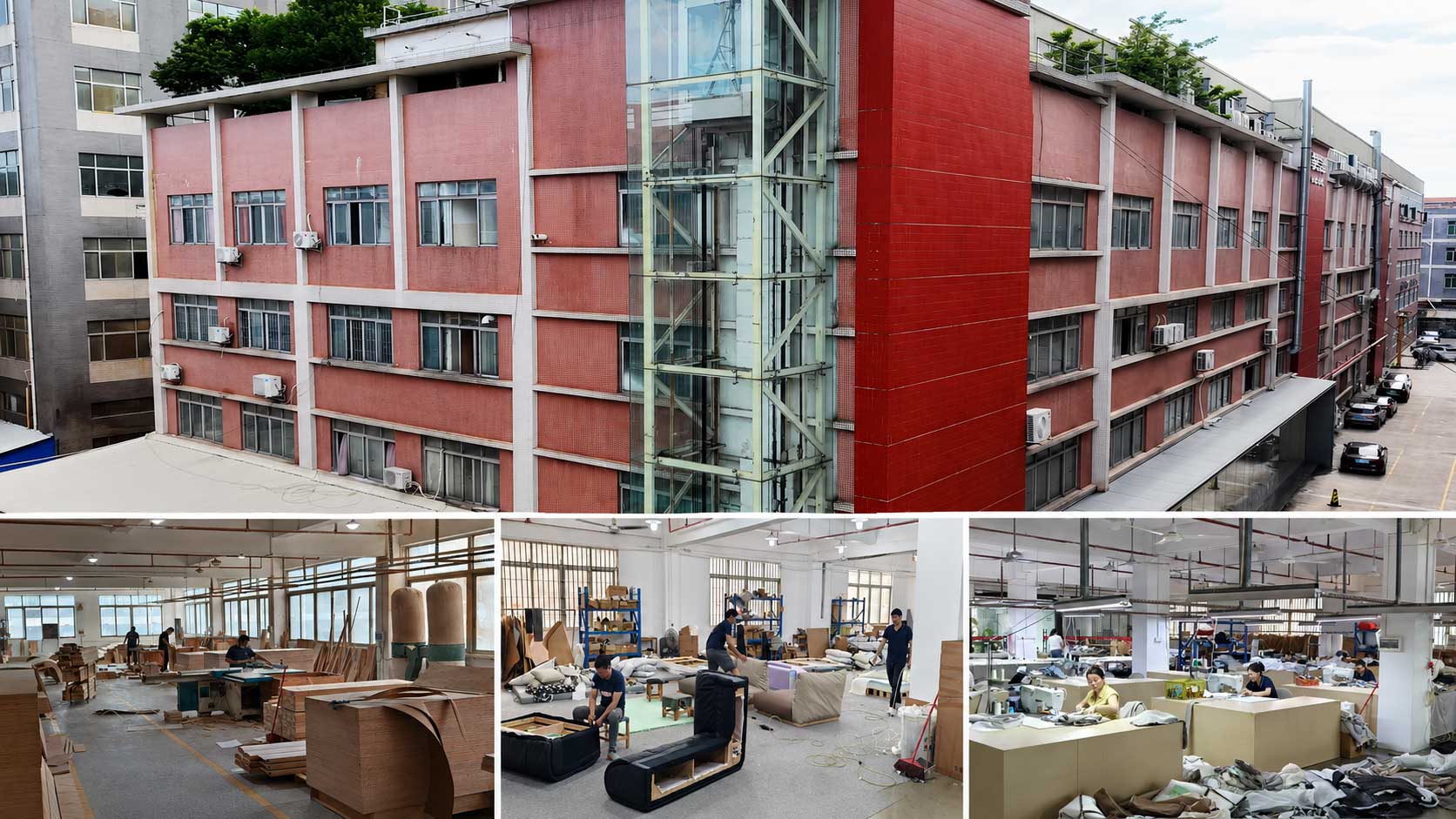
A long supplier list feels productive, but it often creates more comparison work without improving the final decision. Once the initial search is complete, use evidence to reduce the list.
Ask each potential supplier for information relevant to the order:
Business and manufacturing location
Main furniture categories actually produced
Factory, workshop and production-process images
Examples of similar materials or construction
Customization and drawing-development process
Sample procedure and realistic development time
Quality control stages and inspection records
Packaging methods for the destination market
Current production capacity and realistic lead time
If a factory visit is not practical, request a live video walk-through of the relevant production areas. A recorded promotional video is useful, but a live view makes it easier to ask questions and connect the workshop to the products being discussed.
Category relevance matters more than a long product list. A factory that understands upholstery construction may be a stronger sofa partner than a company showing hundreds of unrelated furniture models.
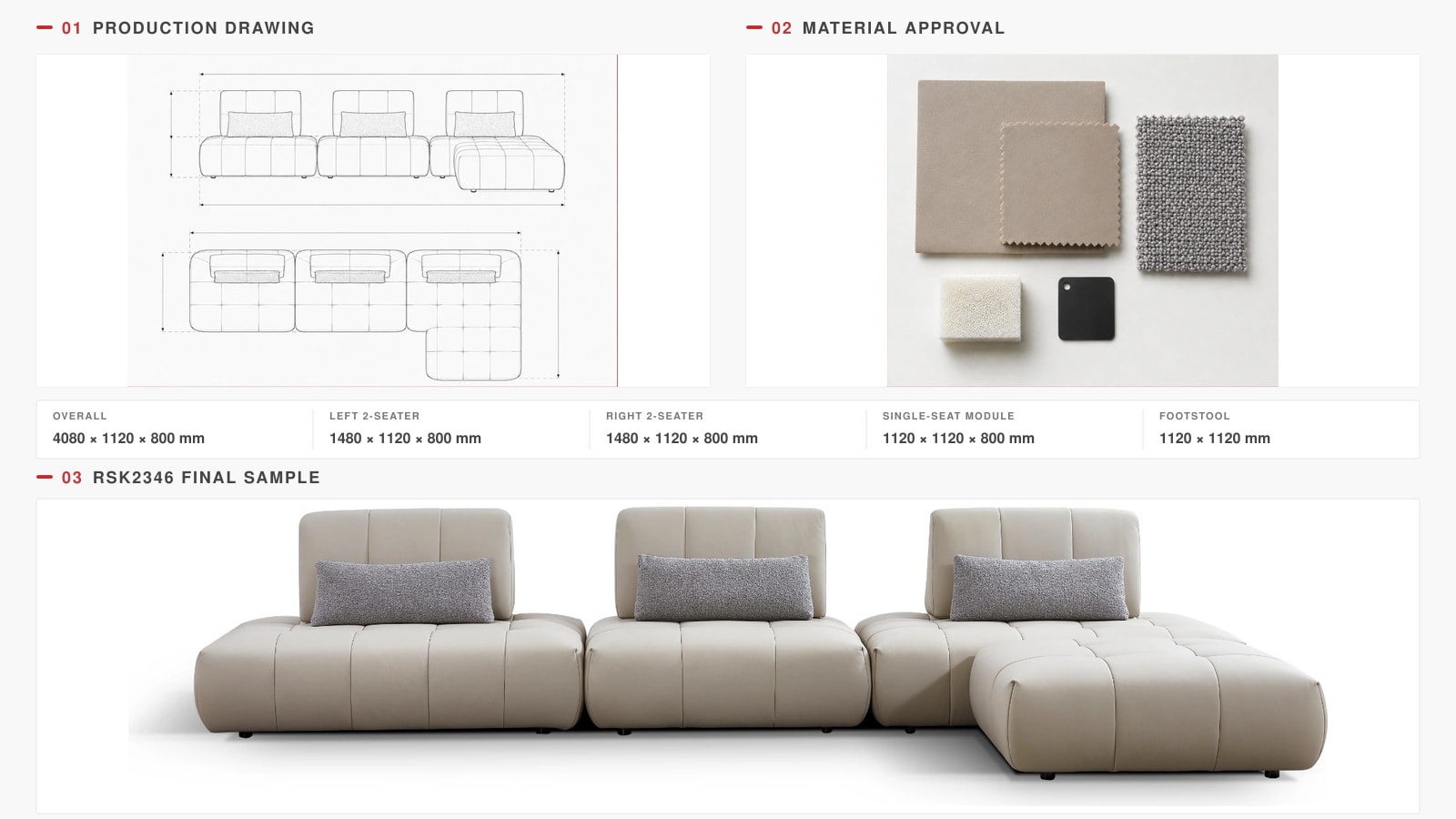
Catalogs create interest. Samples create evidence.
For custom wholesale furniture, the sample should be checked against the written specification rather than judged only by whether it “looks good.”
A sample review may cover:
Overall and functional dimensions
Product proportions and visual balance
Seat comfort or operating function
Frame and connection stability
Upholstery, stitching and seam alignment
Material colors and finish consistency
Hardware operation and installation details
Packaging method and assembly instructions
Record every approved correction. If the seat depth changes, the fabric is replaced or a metal finish is adjusted, that revision should appear in the current drawing, material schedule or approval document.
The final approved sample is often treated as a reference sample for bulk production. It should be identified clearly and protected from informal changes after approval.
A unit price can look attractive because several costs have not yet been discussed. Before comparing suppliers, place each quotation into the same cost structure.
| Cost Area | Questions to Ask |
|---|---|
| Product price | Which dimensions, materials and construction are included? |
| Design development | Are drawings, 3D visualization and revisions included? |
| Samples | What is the sample cost, and what happens after approval? |
| Material upgrades | Are alternative leather, fabric, stone or hardware options extra? |
| Packaging | Does the price include export protection, labels and custom cartons? |
| Inspection | Are in-process reports or third-party inspections included? |
| Transport | Which trade term is used, and where does supplier responsibility end? |
| Replacement support | How will approved manufacturing defects or missing parts be handled? |
The most useful quotation is not necessarily the lowest. It is the one that makes fewer costs and responsibilities appear unexpectedly later.
Buyers often ask for the minimum order quantity before discussing the product. Manufacturers, meanwhile, may need to understand the materials, colors, packaging and production process before giving a useful answer.
A wholesale furniture order can involve several different minimums:
Minimum quantity per model
Minimum quantity per fabric or leather color
Minimum material purchasing quantity
Minimum quantity for custom packaging
Minimum total order value
Different requirements for samples and repeat orders
Ask why a minimum exists. It may be linked to a fabric roll, special metal finish, printed carton, production setup or material supplier requirement. Once the reason is understood, the buyer and manufacturer may be able to create a more workable assortment.
For example, a retailer may keep one upholstery color across several sofa models, or use the same metal finish across dining chairs, sideboards and tables. This can improve collection consistency while simplifying material purchasing.
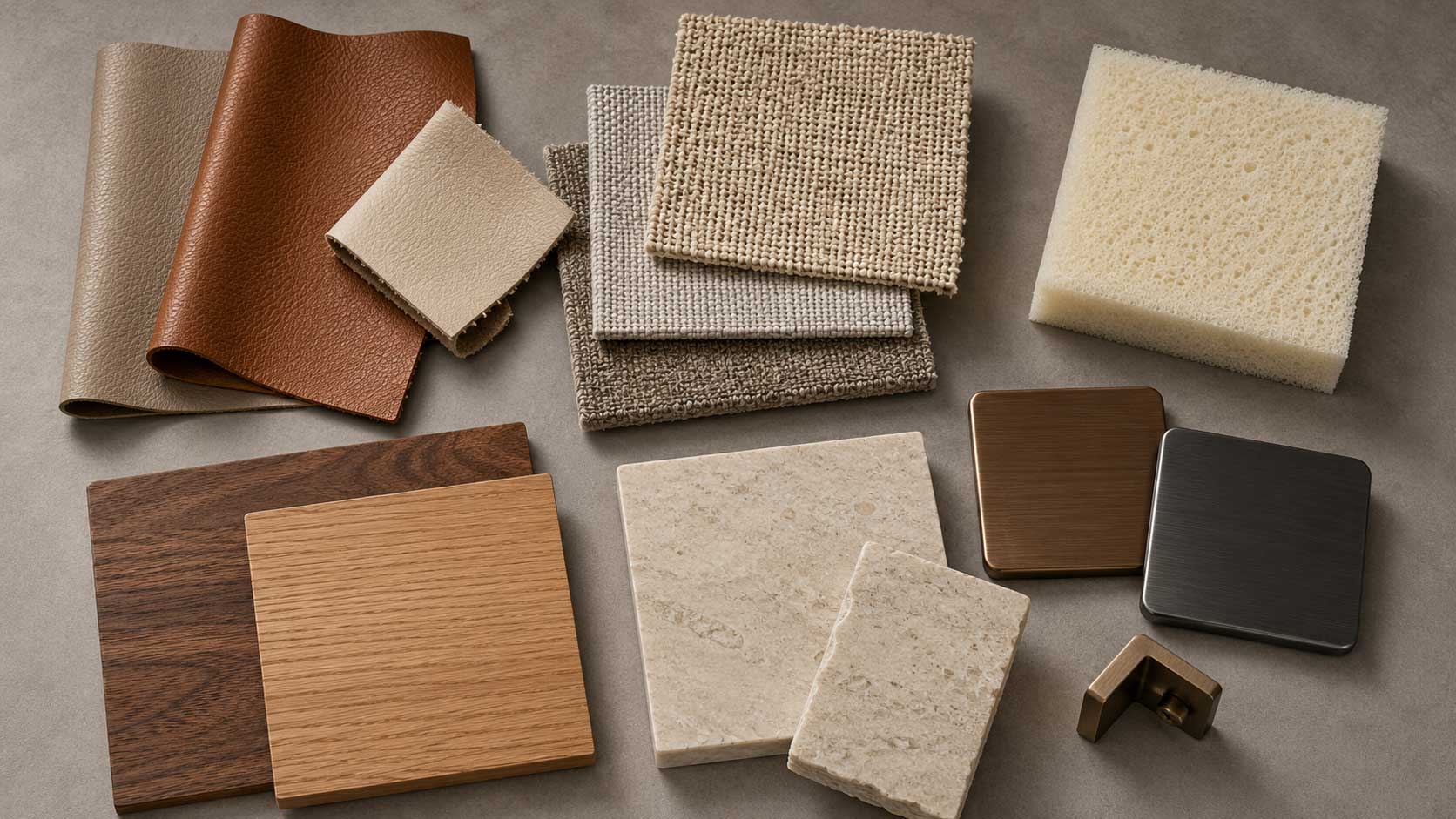
Material descriptions are not the place for creative interpretation. “Luxury fabric,” “solid structure” and “premium foam” may sound positive, but they are difficult to inspect.
A stronger specification identifies details such as:
Leather grade and the areas where it will be used
Fabric supplier code, color and composition
Foam density, firmness and layer construction
Frame material and structural method
Wood veneer species, grain direction and finish
Stone type, thickness and expected natural variation
Metal material, color and surface treatment
Hardware type, function and finish
Digital images are useful for narrowing choices, but final colors and textures should be approved using labeled physical samples whenever possible. The warm grey seen on one screen can become a noticeably different grey under showroom lighting.
Natural leather, wood veneer and stone also vary. A good approval process defines what variation is expected and what would be considered outside the accepted range.
Once an order enters production, communication should become more structured, not less. Buyers need enough visibility to catch a problem before it reaches final inspection.
Brief and feasibility review
Confirm quantities, design requirements, budget direction and timing before detailed development begins.
Drawings and material development
Review dimensions, construction, layouts, colors and finish samples.
Sample or pre-production approval
Record corrections and transfer the approved details into the current production documents.
Bulk production
Receive progress updates at agreed milestones rather than waiting until the order is complete.
Inspection and packing
Check products against the approved sample, drawings, quantities, labels and packaging requirements.
Delivery and repeat-order records
Keep the final specifications, material codes and product images for future replenishment or project extensions.
Change control is especially important. If a material becomes unavailable or a construction detail needs adjustment, the supplier should explain the effect on appearance, price and lead time before making the change.
Wholesalers need products that work together commercially. Dimensions, materials, colors and price levels should form a coherent assortment rather than a collection of unrelated factory offers.
Repeatability matters. Record which specifications must remain stable and which elements may be adjusted for future customers.
A display sample may remain on the showroom floor for months before the next order is placed. Retailers should preserve fabric codes, finish samples, drawings, packaging details and product photography so that future orders can be compared with the original.
Sourcing agents often translate between buyer expectations and factory production. Their value depends on keeping quotations, revisions, approvals and inspection results traceable.
When several suppliers are involved, consistent templates for specifications and reporting make comparison much easier.
Contractors need furniture to arrive in the correct quantity, for the correct room and at the correct stage of the project. Product codes, room labels, phased packing and delivery access may be just as important as the appearance of the furniture itself.
Use a weighted score instead of making the decision from one impressive showroom visit or one low quotation.
| Evaluation Area | Suggested Weight |
|---|---|
| Relevant product and category experience | 15% |
| Customization and technical development | 15% |
| Material and sample accuracy | 15% |
| Quality control system | 15% |
| Quotation completeness | 10% |
| Capacity and lead-time reliability | 10% |
| Communication and document control | 10% |
| Packaging and delivery support | 10% |
A supplier that clearly explains its limitations can be safer than one that says yes to every request. Honest gaps can be planned around. Hidden gaps usually appear during production.
RSKING is a Foshan-based custom furniture manufacturer working with design-led residential, retail and interior project requirements.
Its manufacturing and project support includes:
A 26,000 m² integrated manufacturing base supporting development, customized production and quality inspection
40+ experienced artisans contributing to upholstery, finishing, assembly and detailed furniture production
20+ quality control checkpoints applied according to the product and project requirements
3D visualization, material review and sample confirmation before approved designs enter bulk production
Custom furniture capabilities across living room, bedroom, dining room, cabinets and tables
Buyers can review RSKING’s furniture collectionsand manufacturing capabilitiesbefore submitting a sourcing brief.
The practical value for wholesalers, retailers and contractors is not simply access to more furniture models. It is the ability to connect dimensions, materials, samples and production requirements within one documented development process.
For an overview of the project stages, visit How to Work with Us.
A complex custom product is quoted from one image with no technical questions.
The supplier says everything can be customized but provides no drawing or sample process.
Materials are described only with general marketing terms.
The sample specification is not linked to the bulk production order.
Price differences or material substitutions are not explained clearly.
Lead times are promised before quantities and materials are reviewed.
Only showroom images are available, with little production evidence.
Packaging and labeling are discussed only after production is complete.
One unclear answer does not automatically disqualify a supplier. A pattern of unclear answers should.
Prepare a written brief covering products, quantities, dimensions, materials, budget direction, packaging and delivery requirements. Send it to a shortlist of relevant manufacturers and compare their technical response, samples, quotations, manufacturing evidence and quality process.
A wholesale warehouse generally supplies products that have already been manufactured or selected for stock. A custom manufacturer develops or adjusts products according to approved dimensions, materials, drawings and order requirements. The right model depends on whether speed or customization is the priority.
Online platforms and websites are useful for discovering suppliers, but they should not be the only verification method. Check the company’s role, production location, relevant capabilities, samples, references, quality procedures and commercial documents before placing a bulk order.
There is no universal MOQ. It can vary by product category, material, color, packaging and production method. Ask for the minimum per model, per finish and for the total order, as these may be different.
Yes. Dimensions, upholstery, colors, finishes, hardware, packaging and product combinations may be adjusted when the product structure and order quantity allow it. Retailers should control the number of options so that the collection remains practical to quote, manufacture and reorder.
Compare relevant product experience, technical support, sample accuracy, quality control, quotation completeness, capacity, communication, documentation and packaging. Price should be reviewed within the complete specification rather than as an isolated number.
Depending on the order, buyers may need to approve product drawings, dimensions, material codes, color samples, hardware, packaging, labels, sample corrections and the final quotation. The current document version should be clear to both parties.
RSKING supports custom furniture development for retailers, wholesalers and project buyers through 3D visualization, material and sample confirmation, customized production and product-specific quality control.
Good wholesale furniture sourcing is rarely about discovering one secret factory with the lowest price. It is about removing uncertainty one decision at a time.
A clear brief leads to a clearer quotation. A confirmed sample creates a stronger production reference. Detailed material codes make repeat orders easier. Timely inspections prevent small issues from becoming expensive ones.
If you are developing a furniture collection or preparing an interior project, send RSKING your product list, quantities, drawings, reference images, target materials and required timeline through the project inquiry pagefor an initial manufacturing review.
Sign up to stay up to date:
Write your email here..
FOLLOW US
On RSKING's social channels


Address : Warehouse B, 3rd Floor, Building 1, No. 2 Lianxin South Road, Sanlian Industrial Park, Wanggang Village, Longjiang Town, Shunde District, Foshan City, Guangdong Province
Service Hotline : +86 757 2336 9686
Contact phone : +86 186 6654 8299
Email : sales@rskingfurniture.com
Copyright © RSKING All Rights Reserved


